Disclosure: kittynex.com participates in affiliate programs including Petlibro, PETKIT, Chewy and Amazon Associates. Affiliate links on this page carry rel="sponsored"; we may earn a commission on qualifying purchases at no extra cost to you.
By Jason Feng, Founder & Researcher. See how this review was researched.
The quick answer
Scoop once a day. Change the entire litter every 2–4 weeks for one cat on clumping litter, sooner as cats are added. Wash the box itself monthly for plastic, or every 1–3 months on a cadence you can actually keep.
Automatic boxes replace the scooping tier, not the others. You empty a sealed drawer instead (every 7–10 days for one cat on a Litter-Robot, per Whisker) and still wash the drum.
Those are floor numbers. Three things move them: cat count, litter type, and how fast your cat decides the box is unacceptable.
Table of contents
- Why three schedules, not one
- Tier 1: how often to scoop
- Tier 2: how often to change all the litter
- Tier 3: how often to deep clean the box itself
- The full schedule, by number of cats
- Automatic boxes: the same job, three different cadences
- Where the sources disagree
- Signs your schedule is too slow
- Our verdict
- Frequently asked questions
- How we researched this
- Sources
Why three schedules, not one
"How often should I clean the litter box" is three different questions wearing one coat.
The first is scooping: removing clumps and solids so the box stays usable. This one is daily, and it decides whether your cat keeps using the box at all.
The second is the full litter change: dumping everything, washing the box, refilling. Weeks.
The third is the deep clean of the box itself, the plastic, the seams, the underside of the rim. Urine seeps into scratched plastic over time, which is why this tier exists separately from a litter swap. Months.
Manufacturers and veterinary organizations publish numbers on all three, and they disagree. We reproduced the disagreement rather than averaging it away.
One structural point first. Frequency is not a substitute for capacity. If a household has one box for three cats, cleaning it six times a day does not fix the problem: the box count does. That arithmetic is covered in how many litter boxes per cat, and it comes before everything on this page.
Tier 1: how often to scoop
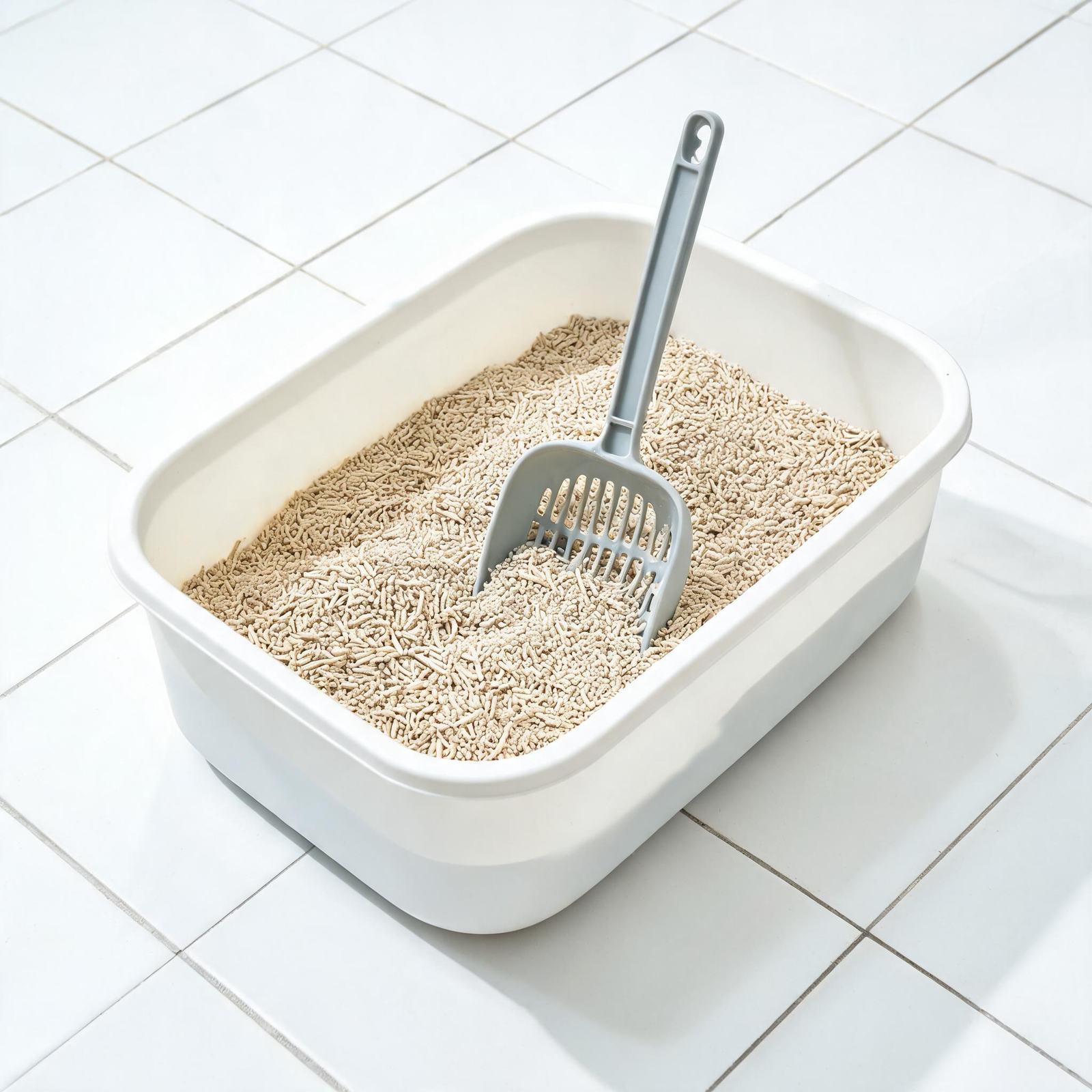
Daily, for any traditional box. That is the one number every source in this article agrees on.
ASPCA puts it at "at least once a day" on both its litter box problems page and its general cat care page. Whisker’s vet-reviewed litter guidance says scoop daily and adds a table that scales by household: every 1–2 days for a single cat, every day for two, twice a day or more for four.
Daily scooping matters more than most owners assume, because the failure mode is not cosmetic. Whisker’s guidance, citing emergency and critical care specialist Dr. Justine Lee, describes cats cutting back to one urination a day rather than stepping into a soiled box. Concentrated urine is where crystals, mucous plugs and the beginnings of feline idiopathic cystitis show up. Cornell’s house soiling page puts the behavioral version bluntly: "Some cats refuse to use a box containing any urine or feces whatsoever."
Here is the practical read. One cat, one box, scooping every other day is survivable. Two cats sharing a box, or any cat with a urinary history, and daily is not optional. If you can smell the box from the next room, you are already two days late.
Our number: once a day, before your cat starts pausing at the entrance.
Tier 2: how often to change all the litter
This is where the published advice splits, far enough to matter.
Whisker’s table pairs a single cat with a full litter change every 2–4 weeks and compresses that to weekly at four cats. ASPCA’s guidance, on both pages we fetched, lands on a week: "Dump everything, wash with a mild detergent and refill at least once a week," with the caveat that you can stretch it "if using clumping litter."
Both describe the same physical process, so the gap is litter type, not an error in one source. Clumping litter lets you remove the urine load with a scoop, so the remaining bed stays usable longer. Non-clumping litter holds everything in place until you dump it. Whisker states that its non-clumping and pellet options "may need more frequent changes," without publishing a number. [DATA NOT VERIFIED: Whisker says non-clumping litter needs more frequent changes but does not publish an interval]
One note from the manufacturer docs: you can stretch a change, but you cannot skip the smell test. Whisker flags a lingering ammonia odor after scooping as the signal that litter has to go, and ideally you change it before it gets there. If smell is the actual complaint, cat litter box odor control covers what the litter, the carbon filter and the enclosure can each do about it, and which of the three is usually the weak link.
Our number: every 2 weeks for a single cat on clumping litter, weekly once three or more cats share one box. Treat 4 weeks as the outer limit.
Tier 3: how often to deep clean the box itself
Scooping and litter changes leave one thing untouched: the box.
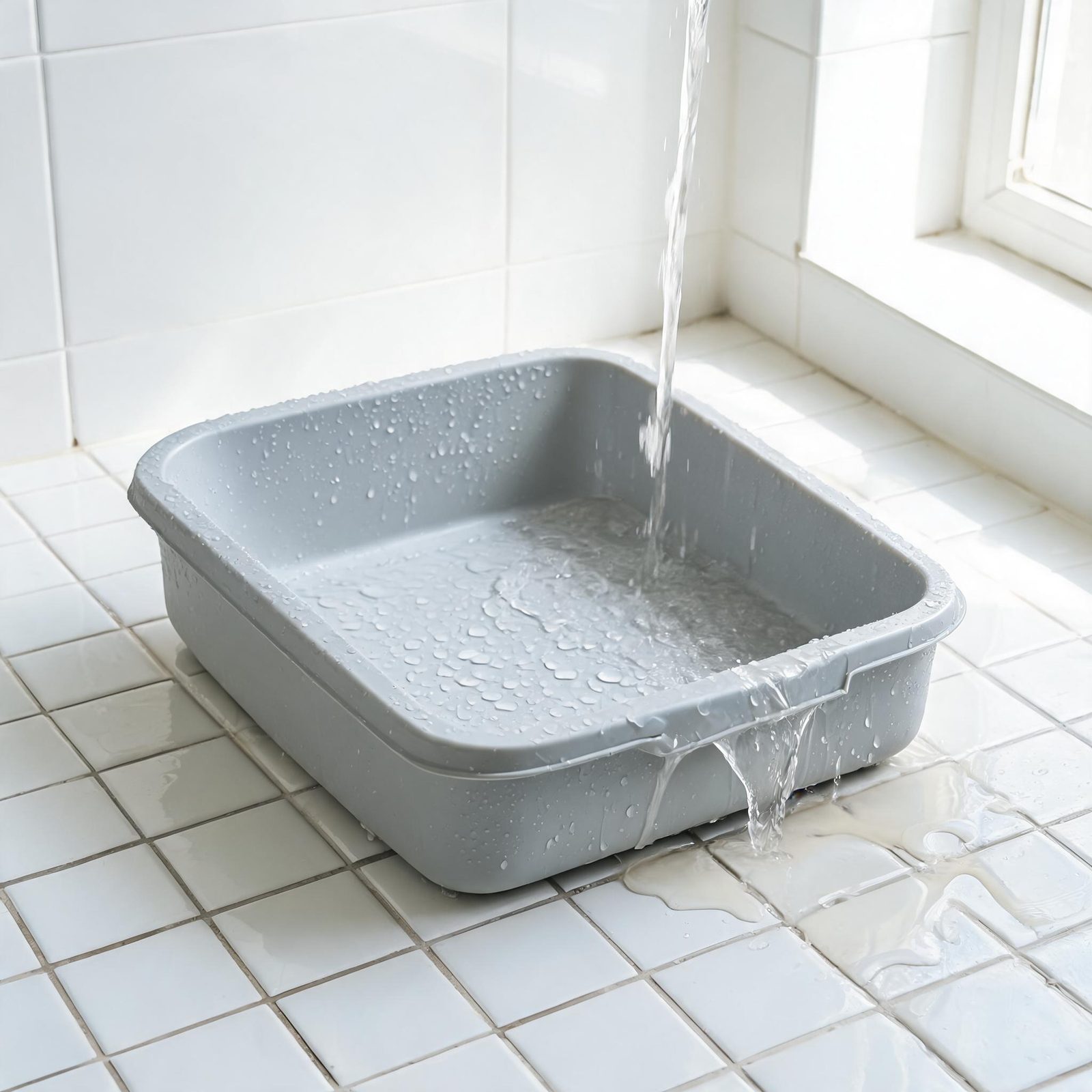
Plastic scratches, and urine gets into those scratches. That is why a box that looks clean can smell wrong minutes after you refill it. Whisker’s cleaning guide recommends an enzyme cleaner or mild dish detergent monthly, and its frequency table scales that to every 3–4 weeks at two cats, every 3 weeks at three, and every 2 weeks at four.
ASPCA’s version is weekly, paired with the litter change: warm water with unscented soap or baking soda.
The gap is real, and it is about the box, not the cat. A large open box with no lid, no liner and no deep scratches tolerates a monthly wash. A covered box, a lined box, or an older box with scratched walls wants closer to every two weeks, because more surface holds odor and less airflow carries it away.
What to clean with:
- Plain unscented soap or baking soda is enough. ASPCA warns against scented cleaners, because a cat can develop an aversion to the scent.
- An enzymatic cleaner is the right tool when urine odor has soaked in. Whisker notes enzymatic cleaners are the effective ones against the compounds behind cat urine smell.
- Keep ammonia away from the box. ASPCA lists it as a mistake because urine contains ammonia, and Cornell’s house soiling page says the same for the same reason: it reads as a scent marker, not a clean surface.
- Gloves. Whisker recommends them, and singles out pregnant and immunosuppressed owners.
Our number: monthly for a plain box, every two weeks for a covered or lined one, and immediately after any illness, diarrhea or accident.
The full schedule, by number of cats
Whisker publishes the most detailed cleaning table in this category. Here it is as published, with box counts from the same manufacturer table.
| Cats in the home | Traditional boxes | Scoop clumps | Change all the litter | Wash the box |
|---|---|---|---|---|
| 1 | 2 | every 1–2 days | every 2–4 weeks | every month |
| 2 | 3 | every day | every 2–3 weeks | every 3–4 weeks |
| 3 | 4 | every day | every 2 weeks | every 3 weeks |
| 4 | 5 | 2+ times per day | every week | every 2 weeks |
Read the bottom row again. Four cats means scooping twice a day or more and a full litter change every single week. That is the honest cost of a manual setup at that size.
If that is where you are, automatic litter boxes for multiple cats works through where one machine genuinely replaces labor and where it does not.
Automatic boxes: the same job, three different cadences
An automatic box does not remove the work. It moves the work onto different clocks.
The scooping tier collapses into one action: emptying a sealed waste drawer, or a bin on machines that pack waste. The litter-change tier mostly disappears, because a sifting mechanism removes clumps and leaves clean litter behind. The deep-clean tier stays. That is the part buyers underestimate.
Whisker’s automatic-box table, as published:
| Cats | Empty the waste drawer | Spot clean | Deep clean |
|---|---|---|---|
| 1 | every 7–10 days | every month | every 3 months |
| 2 | every 4–6 days | every 2 weeks | every 2–3 months |
| 3 | every 2–3 days | every 1–2 weeks | every other month |
| 4+ | every 1–2 days | every week | every month |
Whisker’s support docs are consistent with the top row: for two average-sized cats, emptying the drawer twice a week is typical; for one cat, once a week is usually sufficient. The globe-cleaning article puts the interior wash at every one to three months, and the cleaning guide says deep cleaning a Litter-Robot 4 or 3 about three times a year.
What other manufacturers publish on waste capacity:
| Machine | Manufacturer-stated waste capacity | Stated multi-cat capacity |
|---|---|---|
| Litter-Robot 4 | drawer "as low as once every 8 days" (1 cat) | up to 4 cats |
| Litter-Robot 5 / 5 Pro | up to 10 days between drawer empties (1 cat) | up to 5 cats |
| PETKIT Purobot Ultra | up to 20 days (1 cat), 10 L bin | multi-cat, no number stated |
| PETKIT Purobot Max 3 | up to 15 days (1 cat), 7 L bin | all breeds and ages, no number stated |
| Petlibro Luma | up to 7 days of waste for 2 cats | recognizes up to 10 cats |
Two caveats, both the manufacturers’ own.
PETKIT’s 20-day figure comes with a condition: in hot and humid conditions it recommends packing the waste more frequently. Auto waste packing also needs you standing at the machine, with the sequence running from an on-screen button through packing, sealing and re-bagging. A 20-day bin is not 20 days of unattended operation.
Petlibro publishes replacement intervals for wear parts rather than a wash schedule: carbon deodorizer and litter mat about every 3 months in a single-cat home. The basket and internal parts are removable for washing, but the page does not put a number on how often. [DATA NOT VERIFIED: Petlibro does not publish a wash interval for the Luma basket]
PETKIT’s Purobot pages have the same gap: thorough waste-capacity figures, no deep-cleaning interval. [DATA NOT VERIFIED: PETKIT Purobot product pages and FAQ publish no deep-cleaning interval]
Litter depth is the other thing automation does not change, and it varies by machine. Whisker’s instruction is to fill to just below the raised fill line with clumping litter, roughly 8–10 lb or 1 gallon, and to press Reset afterward so the weight scale re-zeros. Overfilling causes cycling problems. For which litters survive a sifting mechanism, the best litter for automatic boxes has the manufacturer lists.
Where the sources disagree
Worth seeing in one place, because most numbers you find online are one of these rows quoted without the others.
| Source | Scoop | Full litter change | Wash the box |
|---|---|---|---|
| ASPCA, litter box problems | "at least once a day" | weekly, with each wash | weekly |
| ASPCA, general cat care | "at least once a day" | "at least once a week," less often with clumping litter | weekly |
| Whisker / Litter-Robot (vet-reviewed) | daily; 1–2 days for one cat | every 2–4 weeks for one cat | monthly; every 1–3 months |
| Cornell, house soiling | no interval published; only that the box must be clean | no interval published | no interval published |
| AAFP/ISFM 2013 environmental needs guidelines | no interval published | no interval published | no interval published |
The veterinary-behavior sources are quiet on intervals on purpose. Cornell and the AAFP/ISFM framework describe litter boxes in terms of choice, separation and access, and treat cleanliness as a condition rather than a schedule. Fair position. No table knows how fast your cat decides a box is unacceptable.
We could not retrieve a Cornell Feline Health Center page devoted to cleaning frequency; the house soiling article is live and we quoted it. The shortest defensible version: scoop daily, change litter every two weeks with clumping litter, wash the box monthly, and let your cat’s behavior override all three numbers.
Signs your schedule is too slow
The schedule is a default, not a diagnosis. These signals say it is wrong for your household.
| What you notice | What it usually means | The fix |
|---|---|---|
| Cat hovers, paws at the rim, enters and leaves without going | The bed is not clean enough for her | Scoop more often, then revisit litter type |
| Ammonia smell returns within a day of scooping | Urine has reached the plastic | Deep clean now; consider replacing a badly scratched box |
| Litter is damp through the bed | Urine is not being clumped out | Shorten the full change interval |
| Accidents outside the box, sudden onset | Rule out medical causes first | Call your vet before changing the schedule |
| One box in a multi-box home goes unused | Placement, not frequency | See the placement section here |
| Cat holds urine, strains, or passes small amounts often | Veterinary issue until proven otherwise | Vet, today |
That last row is not a cleaning question. Cornell’s house soiling page lists urinary inflammation, kidney disease, diabetes and thyroid disease among the medical causes. Cleaning more often fixes none of them.
Our verdict
Scoop daily, change the litter every 2 weeks for a single cat on clumping litter, and wash the box monthly. Those three numbers cover the vast majority of single-cat households and sit between the strictest and loosest published guidance.
On an automatic box, the same tiers apply with one substitution: scooping becomes emptying the waste drawer, and Whisker’s figure of every 7–10 days for one cat is the number to plan around. The deep clean, every 1–3 months, is the tier owners skip and then complain about smell. Do not skip it.
Three or more cats on manual boxes? The published table is not gentle: scooping becomes twice-daily, and the full litter change becomes weekly. Our pick for that household is to automate the scooping tier and keep more plain boxes than feel necessary, because the machine solves freshness and the extra box solves access. See automatic litter boxes for multiple cats for where that trade pays.
What we would not recommend: buying an automatic box and treating the deep clean as optional, or cutting the box count because cleaning got easier. Both shortcuts surface as the same complaint about smell.
Frequently asked questions
How often should I scoop a traditional litter box?
Scoop clumps and solids at least once a day for any traditional box. Whisker’s vet-reviewed guidance scales this to every 1–2 days for a single cat, every day for two cats, and twice a day or more for four cats.
How often do I need to completely change all the litter?
For one cat on clumping litter, change the entire litter every 2–4 weeks, with 4 weeks as the outer limit. Once three or more cats share one box, change it weekly.
How often should I wash the litter box itself?
Wash a plain open box monthly, or every two weeks if it is covered, lined, or has scratched walls. Wash immediately after any illness, diarrhea, or accident.
Do automatic litter boxes mean I never have to clean the litter box?
No. An automatic box replaces the scooping tier with emptying a sealed waste drawer, but the deep-clean tier stays and is the part buyers underestimate.
How often do you empty an automatic litter box waste drawer?
For one cat, Whisker’s table says every 7–10 days, and its support docs say once a week is usually sufficient. For two average-sized cats, emptying the drawer twice a week is typical.
What should I clean a litter box with?
Plain unscented soap or baking soda is enough, and an enzymatic cleaner is the right tool when urine odor has soaked in. Keep ammonia away from the box, since urine contains ammonia and it reads as a scent marker rather than a clean surface.
How we researched this
- Manufacturer documentation first. Every frequency here comes from a page we fetched directly: Whisker’s two cleaning tables and its waste-drawer, globe and litter-level support articles, PETKIT’s Purobot pages and compare table, and Petlibro’s Luma page.
- Veterinary and welfare sources for the health claims, quoted rather than paraphrased: ASPCA’s litter box problems and general cat care pages, Cornell’s house soiling article, and the AAFP/ISFM 2013 environmental needs guidelines.
- We reproduced the disagreement instead of resolving it. ASPCA says weekly for the full litter change; Whisker says 2–4 weeks for one cat on clumping litter. Both appear with attribution.
- Gaps are marked, not filled. Where a manufacturer publishes no deep-cleaning interval, or says only that non-clumping litter needs more frequent changes, the text says so rather than borrowing another brand’s number.
- Where a number is a manufacturer claim about its own product, we label it as one. This is a research-based review of published documentation, veterinary guidance and aggregated owner reporting.
Read our full methodology and sourcing standards.
Sources
Fetched directly on 2026-09-24:
- https://www.litter-robot.com/blog/how-often-to-change-cat-litter/
- https://www.litter-robot.com/blog/how-to-clean-a-litter-box/
- https://www.litter-robot.com/support/article/how-often-do-i-need-to-empty-the-waste-drawer/
- https://www.litter-robot.com/support/article/how-often-do-i-have-to-clean-the-inside-of-the-globe/
- https://www.litter-robot.com/support/article/how-often-do-i-need-to-add-litter/
- https://www.litter-robot.com/support/article/how-much-litter-do-i-put-in-litter-robot/
- https://www.litter-robot.com/litter-robot-4.html
- https://www.litter-robot.com/litter-robot-5.html
- https://www.petkit.com/products/purobot-ultra
- https://www.petkit.com/products/purobot-max-3-automatic-cat-litter-box
- https://petlibro.com/products/luma-smart-litter-box
- https://www.aspca.org/pet-care/cat-care/common-cat-behavior-issues/litter-box-problems
- https://www.aspca.org/pet-care/cat-care/general-cat-care
- https://www.vet.cornell.edu/node/3981
- https://catvets.com/guidelines/practice-guidelines/environmental-needs-guidelines
Attempted but not retrieved: a dedicated Cornell Feline Health Center litter box cleaning-frequency page, PetMD’s litter box cleaning article, and VCA Hospitals’ litter box page. All three returned errors or moved. No claim in this article depends on them.