Disclosure: kittynex.com is reader-supported. Any affiliate link on this page is marked rel="sponsored", and we may earn a commission on qualifying purchases at no extra cost to you. Commissions never determine our rankings.
By Jason Feng, Founder & Researcher. See how this review was researched.
The short answer
An automatic litter box does not replace the n+1 rule, and a manufacturer’s cat count is not a territory count. For a two- or three-cat home, our pick is the Litter-Robot 5 at $799, which Whisker rates for up to 5 cats, used alongside at least one plain open box in a different room.
Keep that second box even though the robot handles the cleaning. Drawer intervals are published for a single cat, and what n+1 protects is access, which no machine supplies from another room.
Table of contents
- What changes when more than one cat uses one box
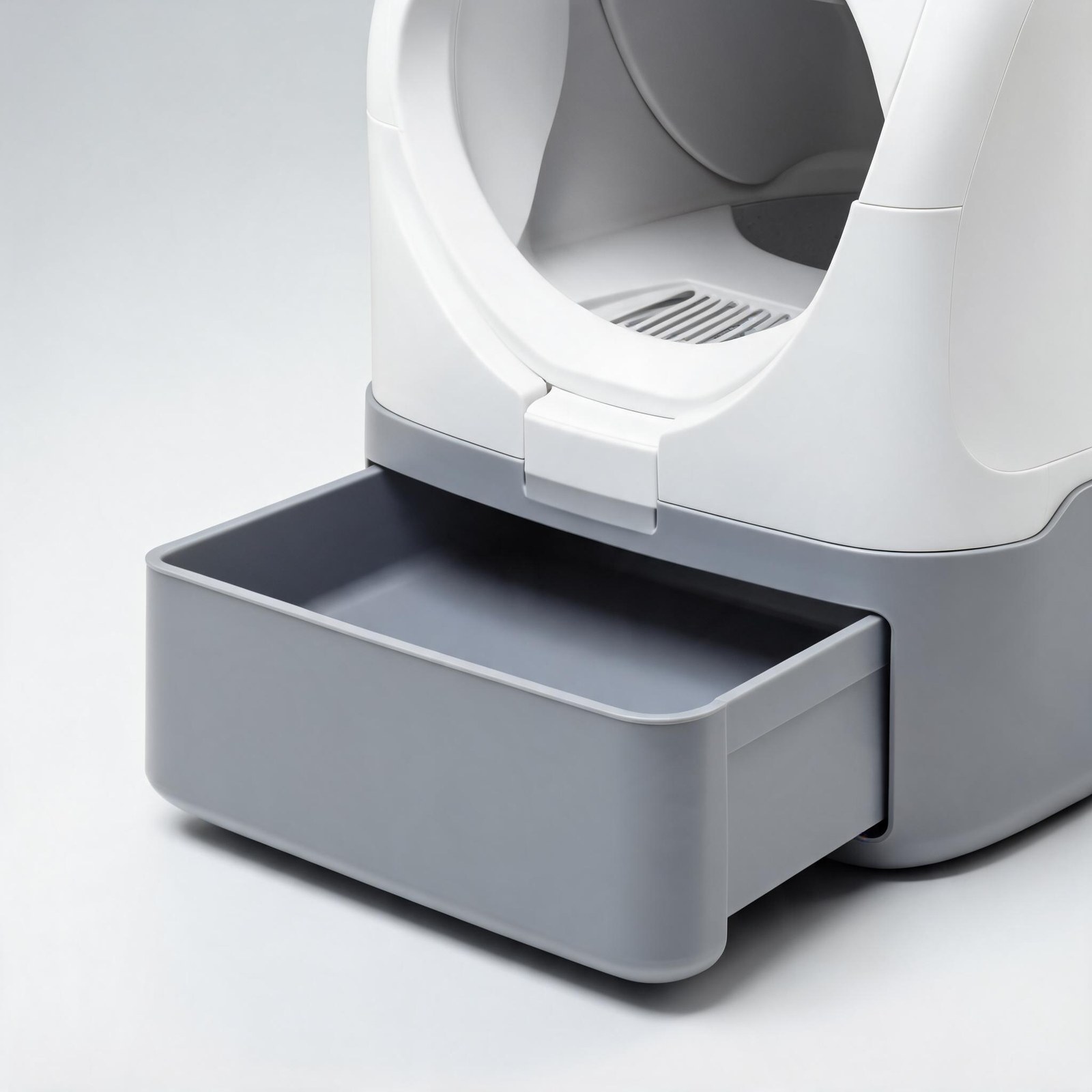
- Capacity: what the waste bins actually hold
- Cleaning frequency scales down faster than you expect
- Traffic conflicts the spec sheets do not measure
- The n+1 fight: can one robot replace four boxes?
- A setup that works by household size
- Model notes for multi-cat buyers
- The first two weeks
- Our verdict
- Frequently asked questions
- How we researched this
- Sources
What changes when more than one cat uses one box
Three things change, and only the first is on the spec sheet.
Capacity drains faster. Every published drawer interval assumes one cat.
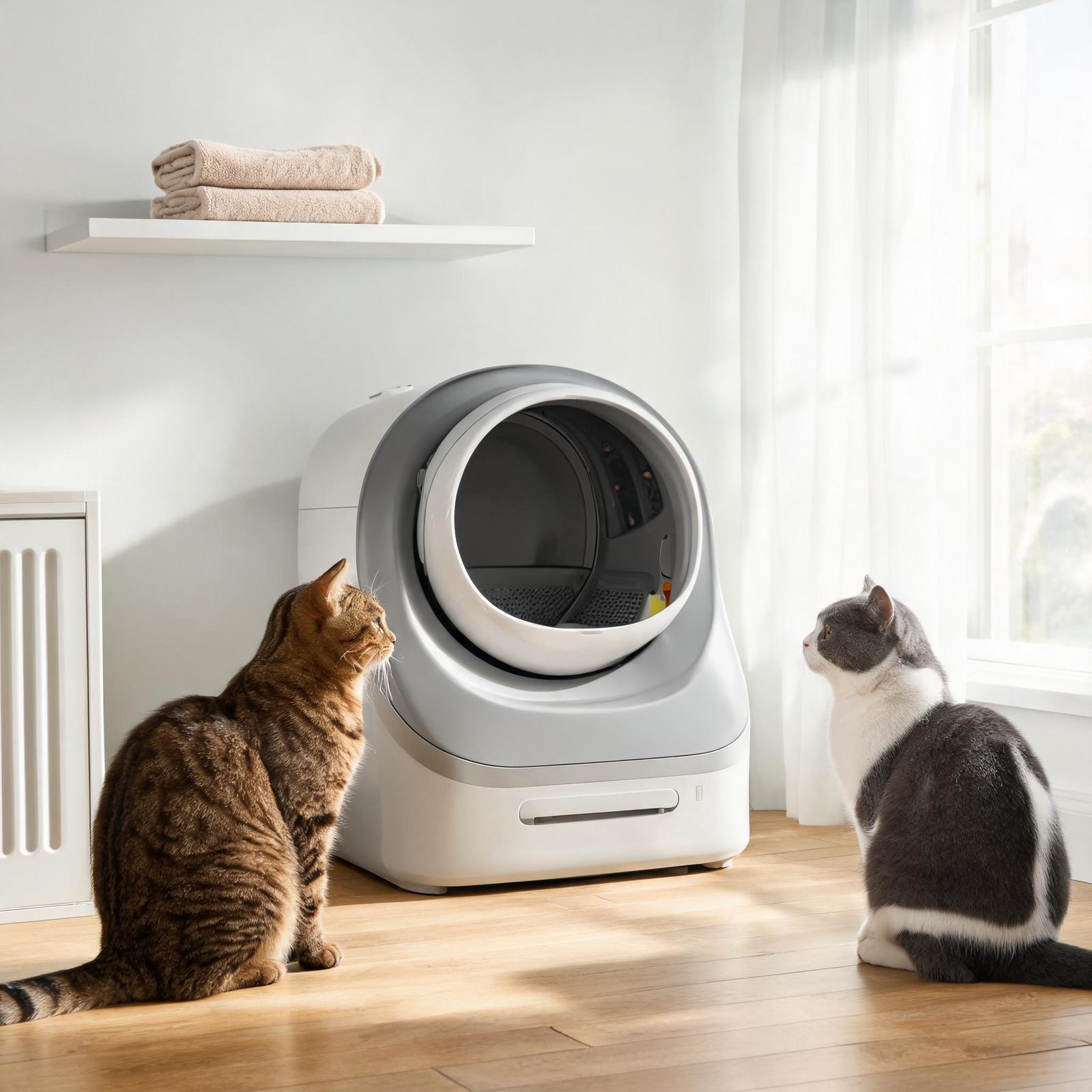
Cleaning cycles overlap. A self-cleaning box rotates, sifts and drops clumps, and none of that happens instantly. A second cat arriving mid-cycle waits.
Territory stops being shared. Owners report this most often, and no manufacturer tests for it. Cats use the same box in a calm house and avoid it in a tense one, with no change to the hardware.
Capacity: what the waste bins actually hold
These are the bin and drawer figures published on the vendor pages, with the manufacturer’s own cat rating beside them.
| Model | Listed price | Manufacturer cat rating | Published bin interval | Bin or drawer size |
|---|---|---|---|---|
| Litter-Robot 5 | $799 | Up to 5 cats, 3–30 lbs | Up to 10 days, one cat | Not published |
| Litter-Robot 4 | $699 | Up to 4 cats, 3–25 lbs | Up to 8 days, one cat | Not published |
| Litter-Robot EVO | $599 | Up to 2 cats, 3–19 lbs | Up to 7 days, one cat | Not published |
| PETKIT Purobot Max Pro 2 | $599.99 | Multi-cat facial recognition, no numeric rating | Not published | Not published |
| PETKIT Purobot Max 3 | $399.99 | Multi-cat tracking, no numeric rating | Up to 15 days, single-cat home | 7L side bin |
| PETKIT Purobot Ultra | $799.99 | Camera recognizes up to 15 cats | Up to 20 days, one cat | 10L bin |
| Petlibro Luma | $599.99 | Identifies up to 10 cats | Up to 7 days for 2 cats | Not published |
| CATLINK Scooper Open-X (multi-cat) | $199 | Multi-cat version, no numeric rating | Up to 15 days, one cat | 12L drawer |
| CATLINK Scoop Robot Pro | $699 | Lifetime multi-cat recognition | Up to 14 days, one cat | 12L bin |
The tempting move is to divide the published interval by your cat count. Whisker’s own support documentation shows where that goes wrong. Its waste drawer article states that for two average-sized cats, emptying the drawer twice per week is typical, closer to every three or four days than the five days a simple halving of the Litter-Robot 5’s 10-day figure suggests. Cats often use the box in clustered visits, so two cats do not consume exactly twice the one-cat rate.
Whisker’s capacity guide is consistent: at four cats, it says the drawer lasts about a couple of days.
That guide also publishes a hard ceiling of "a maximum of 4 cats per Litter-Robot," even on the model it sells as good for five. The five-cat rating is a capability claim about the hardware, not a recommendation for your household. I would treat 4 as the planning number and 5 as the marketing number.
For PETKIT, the same single-cat caveat sits on both flagship pages. The Max 3’s 15 days and the Ultra’s 20 days are one-cat figures, and PETKIT’s FAQ says the replacement frequency "depends on the number of cats in your household and their litter box usage patterns" without saying by how much. Honest, and not much help for planning.
[DATA NOT VERIFIED: no vendor in this comparison publishes a bin capacity alongside a cat-count conversion, such as liters of waste per cat per day. Multi-cat intervals therefore cannot be calculated from published primary sources, which is why the table above lists the one-cat figures only.]
One model in the table behaves differently on purpose. The Petlibro Luma publishes its storage claim for two cats rather than one, the only directly comparable multi-cat number here. It is also the shortest, and Petlibro footnotes it as internal testing.
Cleaning frequency scales down faster than you expect
Whisker publishes a cleaning-frequency table that pairs box count, scooping cadence and full litter changes with the number of cats, and breaks out what changes once the box is self-cleaning. Both versions are useful even if you never buy a Litter-Robot.
| Cats | Recommended boxes (manual setup) | Manual scooping | Full litter change | Robot: empty waste drawer | Robot: deep clean |
|---|---|---|---|---|---|
| 1 | 2 | Every 1–2 days | Every 2–4 weeks | Every 7–10 days | Every 3 months |
| 2 | 3 | Every day | Every 2–3 weeks | Every 4–6 days | Every 2–3 months |
| 3 | 4 | Every day | Every 2 weeks | Every 2–3 days | Every other month |
| 4+ | 5+ | 2+ times per day | Every week | Every 1–2 days | Every month |
Read the last two columns as the real cost of a multi-cat automatic setup. A three-cat household empties a waste drawer roughly every 48 to 72 hours per unit, and wipes down the globe every other month. Automation removes scooping, not litter handling, and it removes less of it with each additional cat. Litter-Robot’s own guidance suggests checking the litter level every time you empty the drawer, which at three cats means every few days. For the three-way breakdown of scooping, full litter changes and deep cleaning on its own, see how often to clean a litter box.
If you are weighing how much of this is recurring cost rather than labor, we priced the liner, filter and cartridge side of it in automatic litter box cost per year. For what happens when the drawer does not get emptied on schedule, see cat litter box odor control.
Traffic conflicts the spec sheets do not measure
Every self-cleaning box pauses its cycle when a cat approaches. Whisker uses weight and laser sensors on the Litter-Robot 5 and a weight sensor on the EVO. PETKIT advertises 12 real-time sensors on the Max 3. Petlibro lists weight, visual, infrared motion and anti-pinch on the Luma. CATLINK describes a 360° infrared and weight system on the Scoop Robot Pro.
Those systems exist because the mechanism is hazardous while moving. While one cat’s cycle runs, another cannot safely use the box.
Whisker documents the timing: the cycle does not begin until minutes after the cat exits, and you can extend that delay to as long as 30 minutes for a nervous cat. A longer delay helps a skittish cat and works against a shared box, because the countdown restarts with every visit.
What no manufacturer publishes is cycle duration in seconds or a max cycles-per-hour rating for the mechanism.
[DATA NOT VERIFIED: no vendor on our list publishes average cycle time, a maximum cycles-per-hour rating, or a duty-cycle limit. PETKIT’s Purobot Max 3 page contradicts itself on noise, stating 35dB in the marketing copy and 45dB in the FAQ, so treat that figure as unresolved.]
The practical takeaway is not "avoid automatic boxes." The queue is real. If your cats toilet around the same times, after meals or first thing in the morning, one unit becomes a bottleneck at exactly those times. A second access point, even a cheap open box, dissolves most of that.
It matters for health data too. These machines identify cats individually, and if identification misses when cats share a box, the per-cat history is wrong for both.
The n+1 fight: can one robot replace four boxes?
The n+1 rule says one box per cat plus one extra. The ASPCA states it plainly: have a litter box for each cat in your household, plus one extra, so three cats means a minimum of four boxes. The veterinary framework behind that guidance, the 2013 AAFP/ISFM Environmental Needs Guidelines, is built around providing key resources in multiple separated locations so cats can avoid conflict instead of competing for them. The guideline summary publishes the framework, not a box count.
Litter-Robot’s own content sits on both sides. One post calls n+1 the gold standard, gives 2 cats = 3 boxes, and warns that cats see side-by-side boxes as a single territory. Another states that a self-cleaning box reduces the need for multiple boxes, and that a Litter-Robot 5 accommodating five cats can replace up to six litter boxes. A third, its capacity guide, recommends a maximum of four cats per unit and lists territorial stress among its reasons.
Those statements are reconcilable. A robot replaces litter box instances, not territory. What n+1 protects is a cat’s ability to reach a clean, quiet, unoccupied place to go. A robot keeps the litter clean and does nothing about the geography.
So the workable rule for multi-cat homes is this: count locations, not boxes. If your robot and your backup box sit in the same corner of the same room, you have one litter area with extra furniture. Put the second one in another room or on another floor.
That reasoning is the basis of our longer piece on how many litter boxes per cat. For which unit to buy at all, the best automatic litter boxes compared covers the field model by model.
A setup that works by household size
| Household | Robot that fits | Plain boxes to keep as backup | Why the backup stays |
|---|---|---|---|
| 1 cat | Litter-Robot EVO ($599) or CATLINK Scooper Open-X single-cat ($169) | 1, if space allows | Lowest cost, smallest footprint; EVO rated to 2 cats |
| 2 cats | PETKIT Purobot Max 3 ($399.99), or Litter-Robot 4 ($699) | 1, in a different room | Whisker’s own guide pairs 2 cats with 3 boxes even without a robot |
| 3 cats | Litter-Robot 5 ($799) | 1, in a different room | Rated to 5 cats; the backup covers territory, not capacity |
| 4 cats | Litter-Robot 5 or 5 Pro ($799/$899) | 1–2, separated | Whisker caps its own recommendation at 4 cats per unit |
| 5 cats | Litter-Robot 5 plus a second unit, or two PETKIT Max 3 | 1 | Whisker’s formula is one unit per 3–4 cats above 4 |
Two things about that table. The EVO is rated to 2 cats, so it is the wrong purchase for a 3-cat home even at $200 less than the Litter-Robot 5. And CATLINK sells the Scooper Open-X as two products, a single-cat version at $169 and a multi-cat version at $199. Buying the cheaper SKU for two cats is a mistake the listing makes easy.
Model notes for multi-cat buyers
The Litter-Robot 5 is the only current model here rated to 5 cats at 3–30 lbs. It adds WasteID, which Whisker says distinguishes urine from feces so the unit can adjust its cycling. Its manufacturer-hosted rating is 4.6/5 across 241 reviews.
The Litter-Robot 4 supports up to 4 cats at 3–25 lbs and has the deepest review base on the list, 4.5/5 across 14,094 manufacturer-hosted reviews. It is also the only current model compatible with the $129 LitterHopper.
The PETKIT Purobot Max 3 is the value play at $399.99, with a 7L side bin rated up to 15 days for one cat. PETKIT’s Purobot Ultra at $799.99 recognizes up to 15 cats and auto-packs waste, but that system runs on proprietary refill rings at $35.99 for three.
The Petlibro Luma at $599.99 is the only unit here publishing a two-cat storage figure (7 days), and it identifies up to 10 cats. Live viewing works without a subscription; AI analysis, event recording and playback do not, and SD cards are not supported, so cloud plans at $95.99 to $159.99 per year are the only route to those features.
Whichever you choose, litter compatibility matters more in a multi-cat home, and our breakdown of litter types for automatic boxes covers which ones hold up under heavy rotation.
The first two weeks
Do not remove your existing boxes when the robot arrives.
Whisker advises leaving the unit powered off while cats adjust, placing it beside the old box, and adding a scoop of used litter so the scent is familiar. That guidance exists because acceptance is not guaranteed. Whisker states that 95% of cats adjust comfortably, based on stated reasons for customer returns of two models over a one-year period. That figure comes from returns data rather than an independent study, so plan for the possibility that one cat in your house is in the other 5%.
For kittens, most vendors set a floor of about 3 lbs before automatic mode is safe. PETKIT cites 6 months and up for the Max 3, and Petlibro instructs owners with kittens under 6 months to switch off auto-cleaning entirely.
Run both setups for at least two weeks, then watch which box each cat uses. If one cat never touches the robot after a month, the n+1 box is no longer a backup. It is that cat’s box.
Our verdict
Buy the Litter-Robot 5 at $799 for a two- or three-cat home, and keep one plain open box in a different room. It is rated to 5 cats at 3–30 lbs, accepts any waste bag, and Whisker publishes the most complete specification and support documentation in this category.
Buy the Litter-Robot 4 at $699 if the LitterHopper matters, since no other current model supports it, or if the 14,094-review base matters more than the newer sensor set.
Buy two PETKIT Purobot Max 3 units instead of one bigger robot if you have two cats and a fixed budget, or a two-floor home. Two units land near the price of one Litter-Robot 5 and give you two locations.
Buy the Litter-Robot EVO at $599 only for one cat, or two cats in a small space. Being rated to 2 cats is what disqualifies it for a three-cat home, not the price.
Do not buy any of these to replace every manual box in a home with four or more cats. That is where the n+1 rule stops being a preference, and where the manufacturer’s own capacity guidance caps its recommendation at 4 cats per unit.
Prices are as listed by each manufacturer on 2026-09-24, in USD, and they move. Verify before you buy.
Frequently asked questions
Can one automatic litter box replace multiple boxes for two or three cats?
No. A robot replaces litter box instances, not territory, and the n+1 rule still applies. For a two- or three-cat home, the pick is the Litter-Robot 5 at $799 used alongside at least one plain open box in a different room.
How often do you have to empty the waste drawer on an automatic litter box with multiple cats?
Published drawer intervals assume one cat, so they drain faster than a simple division suggests. Whisker’s documentation states that for two average-sized cats, emptying the drawer twice per week is typical, and at four cats the drawer lasts about a couple of days.
What is the maximum number of cats per Litter-Robot?
Whisker publishes a hard ceiling of a maximum of 4 cats per Litter-Robot, even on the model it sells as good for five. The five-cat rating on the Litter-Robot 5 is a capability claim about the hardware, not a household recommendation.
Which automatic litter box is best for a two-cat home?
The Litter-Robot 5 at $799 is the pick for a two- or three-cat home, kept alongside one plain open box in a different room. The PETKIT Purobot Max 3 at $399.99 is the value option, and two of them can be bought instead of one bigger robot for a two-cat home on a fixed budget.
Can I use an automatic litter box for kittens?
Most vendors set a floor of about 3 lbs before automatic mode is safe. PETKIT cites 6 months and up for the Max 3, and Petlibro instructs owners with kittens under 6 months to switch off auto-cleaning entirely.
Do cats accept an automatic litter box right away?
Acceptance is not guaranteed. Whisker states that 95% of cats adjust comfortably, based on returns data rather than an independent study, so plan for the possibility that one cat is in the other 5%.
Should I remove my old litter boxes when I get an automatic litter box?
No. Whisker advises leaving the unit powered off while cats adjust, placing it beside the old box, and adding a scoop of used litter so the scent is familiar. Run both setups for at least two weeks before deciding.
How we researched this
- Every specification, cat rating, bin size, drawer interval and price here was read from the manufacturer’s own product page or support documentation on 2026-09-24, through a US proxy with an en-US language header so US pricing and US model variants were returned.
- We checked the n+1 rule against the ASPCA’s litter box guidance, the 2013 AAFP/ISFM Environmental Needs Guidelines summary, and Litter-Robot’s own publications, which disagree with each other on how far a robot substitutes for box count.
- Capacity and cleaning-frequency figures are manufacturer claims about their own products, not third-party measurements. Interval figures are single-cat numbers unless the vendor stated otherwise.
- This is a research-based review. Specifications come from manufacturer documentation, with owner-reported failure patterns aggregated across public reviews and community threads. Where a number could not be verified from a primary source, we marked it
[DATA NOT VERIFIED]rather than estimating it. - Read more about how we research and our affiliate disclosure.
Sources
Fetched directly on 2026-09-24 through a US egress with an en-US language header:
- https://www.litter-robot.com/litter-robot-5.html
- https://www.litter-robot.com/litter-robot-4.html
- https://www.litter-robot.com/litter-robot-evo.html
- https://www.whisker.com/litter-robot-comparison-chart
- https://www.litter-robot.com/blog/how-many-litter-robots-for-how-many-cats/
- https://www.litter-robot.com/blog/can-two-cats-share-a-litter-box/
- https://www.litter-robot.com/blog/how-often-to-change-cat-litter/
- https://www.litter-robot.com/blog/how-much-cat-litter-to-use/
- https://www.litter-robot.com/acclimating-your-cat.html
- https://www.litter-robot.com/support/article/how-often-do-i-need-to-empty-the-waste-drawer/
- https://www.litter-robot.com/support/article/how-often-do-i-have-to-clean-the-inside-of-the-globe/
- https://www.litter-robot.com/support/article/how-often-do-i-need-to-add-litter/
- https://www.whisker.com/whisker-plus
- https://www.petkit.com/products/purobot-max-3-automatic-cat-litter-box
- https://www.petkit.com/products/purobot-ultra
- https://www.petkit.com/products.json?limit=250
- https://petlibro.com/products/luma-smart-litter-box
- https://petlibro.com/products/luma-smart-litter-box.json
- https://petlibro.com/pages/video-cloud-ai
- https://www.catlinkus.com/collections/catlink-scooper
- https://catlinkus.com/products.json?limit=250
- https://www.aspca.org/pet-care/cat-care/common-cat-behavior-issues/litter-box-problems
- https://catvets.com/guidelines/practice-guidelines/environmental-needs-guidelines
Sources we attempted but could not retrieve (404, blocked, or moved), and which no claim here depends on: Whisker’s support search, individual CATLINK product pages, the Cornell Feline Health Center litter box pages, VCA Hospitals and PetMD litter box articles, the Indoor Pet Initiative litter box page, and the Merck Veterinary Manual litter box entry.