Disclosure: kittynex.com participates in affiliate programs. If you buy through a link on this page, we may earn a commission at no extra cost to you.
By Jason Feng, Founder & Researcher. See how this review was researched.
Quick answer
Entry height decides this purchase, not price. The lowest verified entry in the current market is PETKIT’s Purobot Crystal Duo at 7.08 inches, then the Max 3 at 8.03. Compare that with 12 inches plus a 6.9-inch step on the Litter-Robot 4 and 13.86 inches on Neakasa’s open-top M1. Under 10 inches is the number to hold for a cat with arthritis.
Table of contents
- Why entry height outranks every other spec
- Verified entry heights across the market
- The arthritis problem
- The cognitive problem is different
- Ramps, steps, and what they actually change
- The failure modes and what each one tells you
- Features that help an old cat and features that do not
- The setup checklist for a senior cat
- Our verdict
- How we researched this
- Sources
Why entry height outranks every other spec
A self-cleaning box asks a cat to climb a threshold, step over a lip, turn in a drum, and step back down. Each is a joint movement.
The ASPCA’s litter box guidance makes the point directly: geriatric cats, overweight cats, and cats with physical limitations will likely be unable to use top-entry boxes or boxes with high sides, and the result is accidents rather than a clean refusal. That is the mechanism you are designing around. A senior cat that cannot make the entry still needs to urinate, so it urinates somewhere the entry is not a problem.
The first number to read is not the drum size, the app, or the price. It is the height the cat must clear and whether a step sits in front of it. Entry height also tracks design type rather than price: a $169 open-top drum has a higher entry than a $399.99 enclosed globe.
Verified entry heights across the market
Every number below comes from the manufacturer’s specification block, read on 2026-10-27. Where a brand publishes nothing, the cell says so.
Table 1. Entry geometry, verified from manufacturer pages.
| Model | Entry height | Entry type | Step or ramp included | Measured footprint |
|---|---|---|---|---|
| PETKIT Purobot Crystal Duo | 7.08 in | Low-profile enclosed | [DATA NOT VERIFIED: box contents not itemized on the Crystal Duo page] | 32.2 by 19.96 by 13.14 in |
| PETKIT Purobot Max 3 | 8.03 in | Enclosed, wide low threshold, entry 10.51 by 10.74 in | [DATA NOT VERIFIED: the Max 3 page does not itemize a step] | 24.4 by 21.2 by 21.7 in |
| PETKIT Purobot Max Pro 2 | 10.03 in | Enclosed, larger opening | [DATA NOT VERIFIED: box contents not itemized on the Max Pro 2 page] | 25.86 by 21.18 by 23.74 in |
| CATLINK Scooper SE | 9.45 in high by 8.38 in wide | Enclosed globe with front entry | Ramp sold separately at $59.99 | 23.58 by 20.98 by 21.46 in |
| CATLINK Scooper Open-X | 13.8 in | Open top on four legs | Ramp sold separately at $69.99 | 25.6 by 23.6 by 27.5 in |
| Neakasa M1 and M1 Lite | 13.86 in | Open top | AirStep sold separately at $59.99 | [DATA NOT VERIFIED: Neakasa’s page publishes no L by W by H footprint] |
| Litter-Robot 4 | 12 in to entrance, 6.9 in step | Enclosed globe, front entry | Fence and step included, Ramp $65 | 22 by 27 in, 22 by 38 in with ramp |
| Litter-Robot EVO | 14.85 in opening | Enclosed globe | Fence included, no step listed | 20.6 by 24.3 in |
| Petlibro Luma | 17.4 in published as entrance | Enclosed | Step in box, mat sold separately | 23.3 by 22.5 by 28.1 in |
Two rows need a warning. The full measurement set, including the 29.5-inch height and the clearances around the machine, is in our Litter-Robot 4 dimensions guide.
The Litter-Robot 4’s "12 inches" is not an entry height in the same sense. Whisker’s drawing puts the entrance 12 inches above the floor with a 6.9-inch step in front of it, so the cat climbs onto a platform and then rises to the lip. The 12-inch figure alone understates the climb, and 6.9 alone understates the total.
Petlibro labels Luma’s 17.4-inch figure as "entrance" without saying which axis, so do not read it as entry height: [DATA NOT VERIFIED: Petlibro does not specify the axis].
The practical read: the three lowest verified entries are all enclosed, at 7.08, 8.03, and 9.45 inches. The open-top drums sit near 13.8 inches because the platform is the point of the design. If a senior cat is the constraint, the enclosed low-entry format is the one to look at, the opposite of what most buying guides assume.
The Crystal Duo row deserves a flag. Its 7.08-inch entry comes with a 13.14-inch height, which is a low, wide box rather than a drum, and its published cat weight limit is stated only as "over 3.3 lbs" with no ceiling. It is the most accessible entry in this market and the least specified product in this table.
The arthritis problem
Feline osteoarthritis is common and under-diagnosed, and it changes litter box behavior early. A cat with sore hips does not jump, does not squat in a deep bed, and may stand at the box edge instead of stepping in. Three mechanical adaptations follow.
Low entry, first. Under 10 inches is the working number, and PETKIT publishes two boxes under it: 7.08 inches on the Crystal Duo and 8.03 on the Max 3. PETKIT’s copy says the low threshold suits senior and short-legged cats. That is marketing, but the dimension behind it is real.
A wide opening, second. CATLINK’s SE publishes its entryway as 9.45 inches high by 8.38 inches wide, a doorway rather than a hatch, and a narrower door would ask the cat to aim. That also makes it a compact box, and our comparison of the smallest automatic boxes has the footprint table for tight bathrooms.
A shallow litter bed, third. This one is in no spec table. A deep fill asks the cat to stand higher than the box floor. Fill to the manufacturer’s line rather than above it.
What we would not do is rely on the automation to compensate. A box that detects the cat and waits does not help a cat that cannot get in.
The cognitive problem is different
An older cat may have healthy joints and still fail this transition, because the failure is memory rather than mobility. Cats build a strong location habit, and a box that moves or changes shape breaks it.
Watch for the specific signals. A cat that walks to where the old box stood and stares at the floor is showing a location habit. A cat that enters, turns, and leaves without posturing objects to the surface or the height. A cat that urinates beside the box is reporting that the entry hurt.
The fix for the first is placement. Put the new box where the old one stood and keep both in place. Whisker’s acclimation guide says not to remove the old box yet, and PETKIT’s transition page says to retire it slowly.
The fix for the second and third is the setup order in our training walkthrough, which sequences the old box, the litter mixing, and the first automatic cycle so nothing moves while the cat is deciding.
One caution: a cat with cognitive decline sometimes needs the old box permanently rather than as a transition aid. Our box count guide covers the arithmetic for households where the number sits above the minimum.
Ramps, steps, and what they actually change
A ramp converts a climb into a slope. That is meaningful for arthritis and marginal for cognitive decline, since the cat still has to choose it.
Verified ramp options:
Table 2. Access ramps and steps, from manufacturer accessory pages.
| Accessory | Price | Fits | Footprint effect |
|---|---|---|---|
| Litter-Robot 4 Ramp | $65 | Litter-Robot 4 only | Extends depth from 27 to 38 in |
| CATLINK Ramp for SE and SE Lite | $59.99 | Scooper SE and SE Lite | [DATA NOT VERIFIED: CATLINK does not publish the added depth] |
| CATLINK Ramp for Open-X and Scoop Robot Pro | $69.99 | Open-X, Scoop Robot Pro | [DATA NOT VERIFIED: added depth not published] |
| CATLINK Ramp for Pro Ultra and Luxury Pro-X | $99 | Pro Ultra, Luxury Pro, Young line | [DATA NOT VERIFIED: added depth not published] |
| Neakasa AirStep | $59.99 | Most litter boxes | 17.4 by 12.6 by 6.5 in, standalone |
| Litter-Robot EVO | [DATA NOT VERIFIED: no ramp sold for EVO, box contents list a fence but no step] | EVO | [DATA NOT VERIFIED: no added footprint to measure] |
The Litter-Robot 4 ramp is the one with a full public spec: 17 by 7 by 22 inches, non-slip rubber feet, no tools required. Whisker states the footprint goes from 22 by 27 inches to 22 by 38 inches with it attached, which is 11 extra inches of floor. Measure that first, because a hallway that fit the box may not fit the box plus ramp.
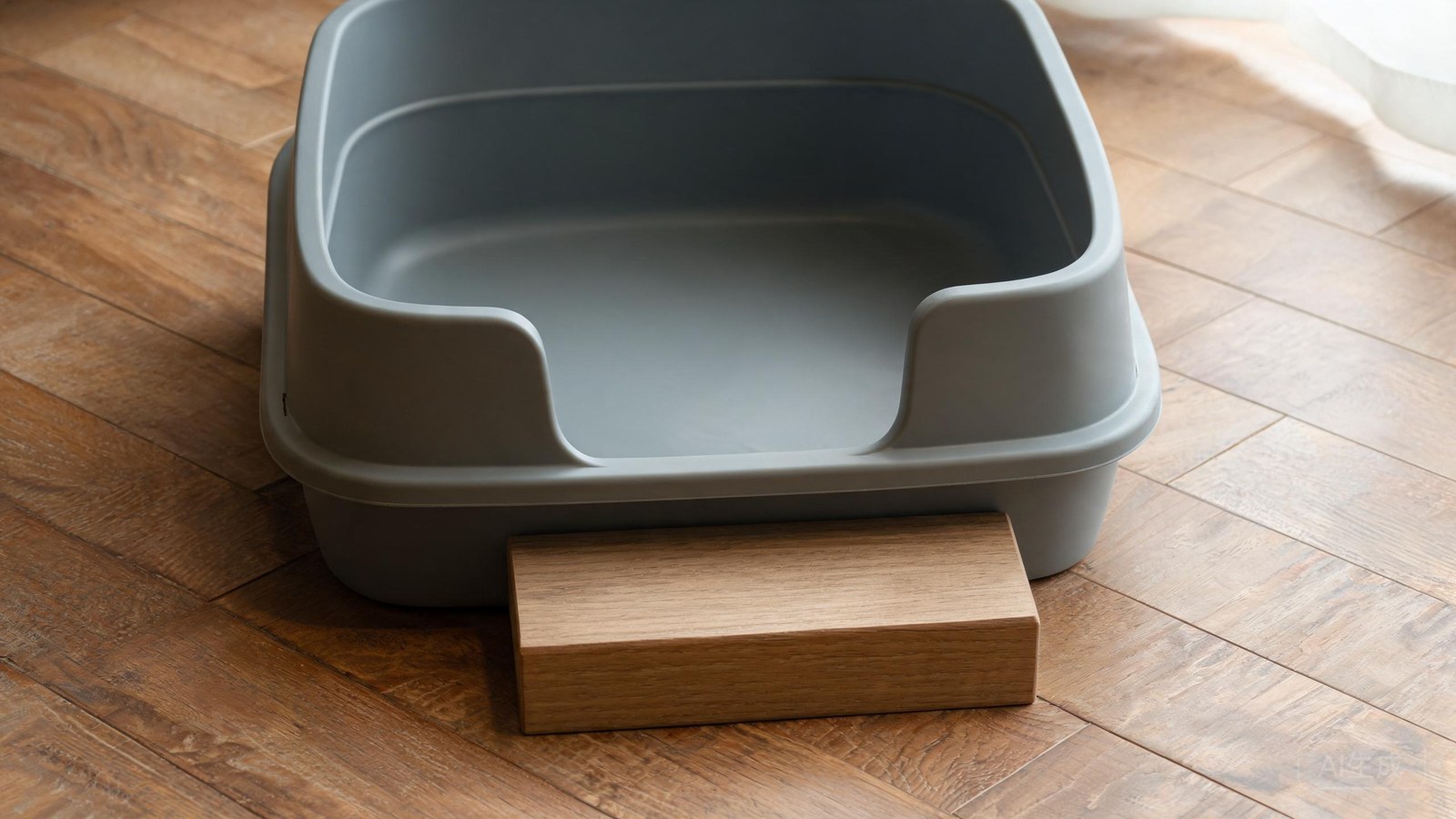
Neakasa’s AirStep is the more interesting accessory because it is general-purpose rather than brand-locked. At 17.4 by 12.6 by 6.5 inches it is a low platform with an air channel and carbon media, and Neakasa says it fits most boxes. For an open top at 13.86 inches, a 6.5-inch step removes about half the climb.
What no ramp fixes: a drum too small to turn in, or a box the cat has decided is frightening. A ramp is an accessibility fix, not an acclimation fix.
The failure modes and what each one tells you
Senior cats fail this transition in recognizable ways, and each points at a different part of the setup.
Table 3. Symptom to cause, for an older cat that is not using the box.
| What you see | Most likely cause | First action |
|---|---|---|
| Urine just outside the entry | Entry too high, or landing too slippery | Add a ramp or step, put a mat on the landing |
| Enters, circles, leaves without going | Litter too deep, or interior too enclosed | Reduce fill to the line, remove the shield or fence |
| Uses the old box only | Location habit intact, new box not yet accepted | Move the new box beside the old one, mix used litter in |
| Uses the box, then avoids it after a cycle | Startled by the motor or drum | Run cycles manually while the cat is elsewhere, then reintroduce |
| Weight readings skip the cat | Cat under the minimum weight threshold | Check the published minimum, not the maximum |
The last row is the one owners miss. Every box has a lower weight limit as well as an upper one, and a cat that has lost weight with age can fall under it. Whisker’s floor is 3 lb, PETKIT’s is 3.3 lb, and CATLINK’s is 3 lb 8 oz.
Weight loss in an older cat is a veterinary question, and the weight log is the useful part. Whisker’s app keeps a 7-day view of visits and weights, with a longer history on Whisker+. That trend line is a better reason to buy a connected box than the scooping.
Features that help an old cat and features that do not
Sorting features by whether they address a senior cat’s limits is worth ten minutes.
Helps: a low threshold, a wide opening, an extendable delay so the cycle does not start while the cat climbs out, a manual cycle button that works without the app, a weight log with a trend, and a ramp the manufacturer sells for that model.
Does not help: a camera, facial recognition, odor chemistry, a bigger drum for a cat that will not enter it, and a cycle the cat fears.
The delay is the one software control that changes behavior for a slow cat. Whisker allows up to 30 minutes before a cycle; CATLINK offers 5, 10, 20, and 30 minute options on the Open-X. A 15-minute delay removes the case where a stiff cat is still half in the globe when it starts to turn.
The drum size question is where senior and large-cat advice collide. A big old cat needs both a low entry and room to turn, and low-entry boxes in this market are the compact ones. Our large-cat selection guide handles the size side, and the honest answer for a 16 lb cat with arthritis is often that no current automatic box is ideal. A low-sided manual pan may serve the cat better than any robot.
The setup checklist for a senior cat
- Weigh the cat and compare it to the published minimum and maximum. A cat that has lost weight may sit close to the floor of the range.
- Set a hard ceiling of 10 inches on entry height, and prefer under 9.
- Check whether a ramp exists for that exact model and price it in. A $59.99 ramp on a $259 box changes the comparison.
- Measure the floor with the ramp attached. The Litter-Robot 4 goes from 27 to 38 inches deep.
- Set the cycle delay to its longest value for the first two weeks.
- Keep the old box in place, uncovered, at the same location, until the new box has a full week of recorded visits.
- Add a mat at the exit so the landing is not slick. Our tracking mat guide covers which surfaces grip.
- Watch the weight trend for the first month. A drop is a vet conversation, not a settings problem.
Our verdict
For a cat with joint trouble, buy the lowest entry you can verify. PETKIT’s Purobot Crystal Duo at $199.99 has a 7.08-inch threshold, the lowest in this market, and its 13.14-inch height means a cat barely has to rise. Its weakness is documentation: no published weight ceiling and no itemized box contents.
The safer pick is PETKIT’s Purobot Max 3 at 8.03 inches with a 10.51 by 10.74 inch opening and a published 22 lb ceiling. The trade is a 7 L bin, which is a one-cat bin.
For a cat that will not accept an enclosed box, Neakasa’s M1 Lite at $328.99 with the $59.99 AirStep gives open access with a 6.5-inch step in front of a 13.86-inch entry, and avoids the door question entirely.
For a Litter-Robot owner whose cat has slowed down, the $65 Ramp is the cheapest real fix in this article and the footprint change is 11 inches of depth. Buy it before you consider replacing the machine.
What we would not do is buy an open-top drum for a cat with arthritis because the price is lower. A 13.8-inch platform is not a senior-cat entry, and the $169 saved becomes a carpet cleaning.
If the cat is both large and old, run the numbers twice. There may be no automatic box that serves both constraints, and a manual pan with one low side is a defensible answer.
How we researched this
- Every entry height, footprint, and weight limit in this article was read from the manufacturer’s own product page on 2026-10-27 through a US egress with an en-US language header.
- Ramp and step prices and dimensions come from the vendors’ accessory pages, including Whisker’s Litter-Robot 4 Ramp page and Neakasa’s AirStep page.
- The clinical framing about geriatric cats and high-sided boxes is attributed to the ASPCA’s published litter box guidance rather than to us.
- Acclimation sequencing follows Whisker’s and PETKIT’s own published transition instructions, which agree on keeping the old box in place and mixing used litter.
- This is a research-based review. Specifications come from manufacturer documentation, with owner-reported failure patterns aggregated across public reviews and support threads.
Our methodology page explains how sources are checked and how affiliate relationships are handled.
Sources
Fetched on 2026-10-27 through a US egress with an en-US language header:
- https://www.petkit.com/products/purobot-max-3-automatic-cat-litter-box
- https://www.petkit.com/products/purobot-crystal-duo-automatic-cat-litter-box-with-camera-gray
- https://www.petkit.com/products/purobot-max-pro-2-automatic-cat-litter-box-with-ai-camera
- https://www.petkit.com/pages/transition-your-cat-to-an-automatic-litter-box
- https://www.catlinkus.com/products/catlink-smart-litter-box-scooper-se
- https://www.catlinkus.com/products/catlink-self-cleaning-litter-box-scooper-open-x-single-cat
- https://www.neakasa.com/products/neakasa-m1-cat-litter-box
- https://www.neakasa.com/products/m1-lite-self-cleaning-cat-litter-box
- https://www.neakasa.com/products/neakasa-airstep-cat-litter-step
- https://www.litter-robot.com/litter-robot-4.html
- https://www.litter-robot.com/litter-robot-4-ramp.html
- https://www.litter-robot.com/litter-robot-evo.html
- https://www.litter-robot.com/acclimating-your-cat.html
- https://www.litter-robot.com/support/article/litter-robot-4-dimensions-comparison-to-litter-robot-3/
- https://petlibro.com/products/luma-smart-litter-box
- https://www.aspca.org/pet-care/general-pet-care/addressing-litter-box-problems