Disclosure: kittynex.com participates in affiliate programs. If you buy through a link on this page, we may earn a commission at no extra cost to you.
By Jason Feng, Founder & Researcher. See how this review was researched.
Quick answer
Match the mat to the litter, not to the box. Honeycomb traps clay and tofu granules and needs shaking out twice a week. Mesh passes fine litter through to a tray and suits large-granule and pellet litter. Fabric catches dust and holds hair. For an automatic box, size matters more than material: Whisker’s mat is $50 and cut for the 22-inch base, Petlibro’s Luma mat is $35.99 at 26.76 by 25.59 inches.
Table of contents
- Why the mat is a litter question
- The three materials and what each one catches
- Verified sizes and prices
- Matching material to litter type
- The exit path decides the size
- The auto-box compatibility trap
- Cleaning time over two years
- The buying checklist
- Our verdict
- How we researched this
- Sources
Why the mat is a litter question
Litter tracking has three inputs: how big the granules are, how much the cat’s paws can carry, and how far the cat walks before the granules fall off.
A mat only addresses the third, and it only works if its openings are sized to the granules. A honeycomb mat with half-inch cells catches a clay granule and lets fine sand pour through onto the floor. A tight mesh catches sand and blinds itself with clay in a week. Buying a mat without knowing the litter is how people end up with a rug that sheds litter back onto the floor.
The exit geometry matters as much as the material. A cat leaving a front-entry globe steps down onto whatever is in front of the door; a cat leaving an open-top drum jumps from a 13.8-inch platform and spreads granules over a wider arc. The mat has to cover the arc, not the doorway.
A mat reduces tracking. It never eliminates it. The mat plus a low-tracking litter plus a longer exit path does the job, and the mat alone does a fraction.
The three materials and what each one catches
The market sells four constructions, and they are not interchangeable.
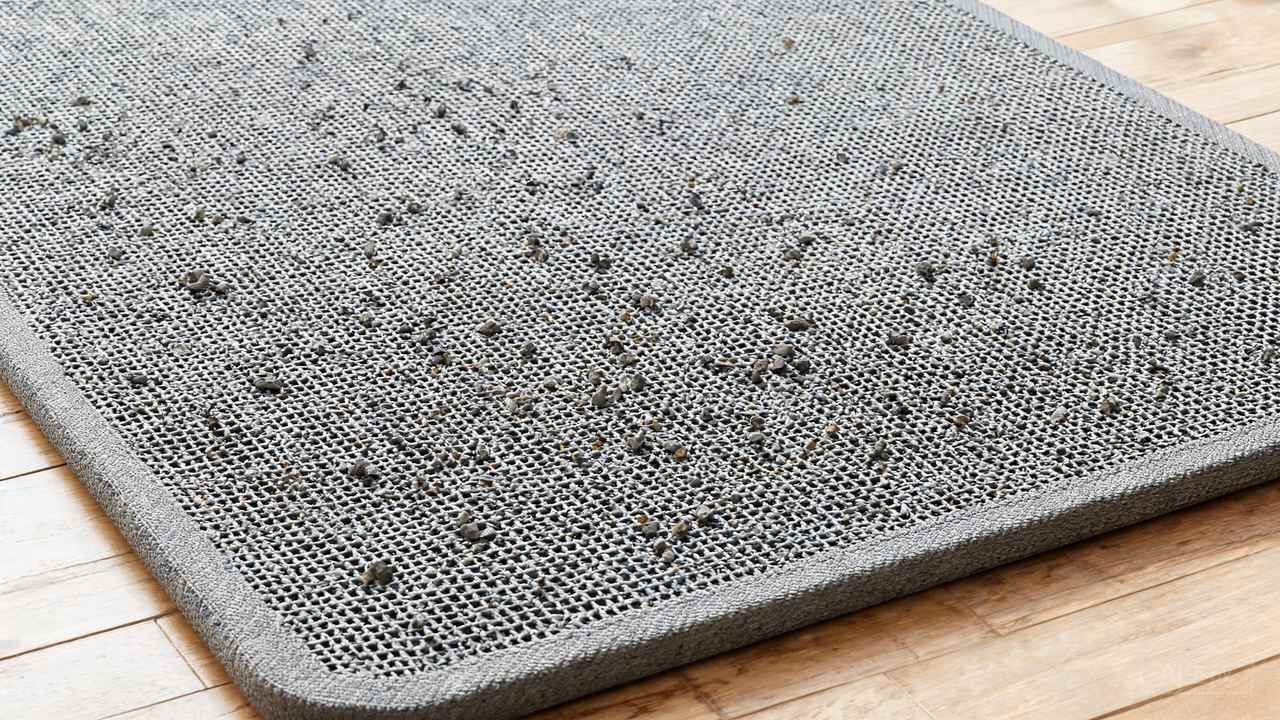
Honeycomb mats have a lattice of large cells over a solid base. Granules drop in and stay until you lift the mat and pour them out. They work on clay and tofu, which form discrete granules that fall into a pocket. They fail on fine sand, which passes through and out the sides, and they fill fast in a multi-cat house.
Mesh mats are a woven or perforated sheet over a tray. The sheet passes fine particles down and holds back larger ones. They suit crystal, pellets, and sand, but clay coats the mesh and stops it passing anything. Whisker describes its LitterTrap Mat as a two-layer design with a top mesh layer you lift off to discard what it caught, which puts it in this family.
Fabric and looped mats are what most people already own. They catch dust and hair and hold odor, and they do not release what they catch. One miss turns a fabric mat into a permanent odor source.
Grooved rubber mats are designed for shoe scraping. They grip the floor well and hold almost no litter, which makes them a good base layer under a honeycomb mat and useless alone.
Table 1. Material against what it actually does.
| Material | Catches | Passes through | Best litter | Cleaning interval |
|---|---|---|---|---|
| Honeycomb | Clay, tofu granules, larger pieces | Fine sand, dust | Clumping clay, tofu | Shake out 2 to 3 times a week |
| Mesh over tray | Fine particles, sand, crystal shards | Nothing larger than the mesh | Sand, crystal, pellets | Empty tray weekly |
| Fabric or looped pile | Dust, hair, some granules | Nothing | None well | Vacuum weekly, replace when odor sets |
| Grooved rubber | Almost nothing | Everything | As a base layer only | Rinse monthly |
The single most common buying mistake is a honeycomb mat under a fine-grained litter. The second is a mesh mat under a heavy clay litter. Both produce the same complaint, which is that the mat does not work.
Verified sizes and prices
These are the mat and step products sold by the box manufacturers themselves, read on 2026-10-27. Sizes matter more than they look, because a mat that is smaller than the box’s footprint leaves a strip of bare floor exactly where the cat lands.
Table 2. Manufacturer mats and steps, verified.
| Product | Price | Dimensions | Material | Made for |
|---|---|---|---|---|
| Whisker Litter-Robot LitterTrap Mat | $50 | [DATA NOT VERIFIED: Whisker does not publish the mat’s dimensions on the product page] | Two-layer with heavy-duty top mesh, urine-repellent | Litter-Robot base |
| Petlibro Luma Litter Trapping Mat | $35.99 | 26.76 by 25.59 in | EVA | Luma only, model PLLP001 |
| Petlibro Luma Replacement Litter Mat | $32.40 sale, $35.99 regular | [DATA NOT VERIFIED: no dimensions published on the listing] | [DATA NOT VERIFIED: material not stated on the listing] | Luma |
| Neakasa AirStep | $59.99 sale, $79.99 regular | 17.4 by 12.6 by 6.5 in | [DATA NOT VERIFIED: Neakasa does not name the material] | Most litter boxes, as a step |
| CATLINK litter pad | Included in the Open-X box | [DATA NOT VERIFIED: sold as a box inclusion, no standalone spec] | [DATA NOT VERIFIED: material not stated] | Scooper Open-X |
Two useful readings from that table.
The Petlibro mat is 26.76 by 25.59 inches and the Luma box is 23.3 by 22.5 inches on the floor, so the mat overhangs by roughly 3 inches per side. That is the right relationship. For a generic mat, use the box footprint plus 3 inches per side as the minimum.
The Whisker mat is a manufacturer selling a mat cut for its own base and publishing almost nothing about it. At $50 the stated advantage is that it is custom-fit to the Litter-Robot base, which is real for a curved front and a limitation if you move the mat to another box.
Matching material to litter type
This is the table to use before you buy anything.
Table 3. Litter format to mat choice.
| Litter format | Recommended mat | Avoid | Reason |
|---|---|---|---|
| Fine clumping clay | Honeycomb with a solid base, or mesh with a tray | Fabric, tight mesh | Clay bridges in a tight mesh and blinds it |
| Coarse clumping clay | Honeycomb | Mesh | Granules are too large to pass through mesh |
| Tofu | Honeycomb | Fabric | Tofu pieces are light and roll, so cells hold them |
| Crystal or silica | Mesh over tray, or a smooth mat | Honeycomb | Crystal shards pass through honeycomb cells and cut feet |
| Pine pellets | Mesh with a tray | Honeycomb | Pellets are large and sit on top of a lattice |
| Grass seed or cassava | Tight mesh with a tray | Honeycomb | Fine particles behave like sand |
| Paper pellets | Mesh | Fabric | Pellets break down into paper dust |
Two rows come from the vendors’ own litter guidance. Petlibro excludes crystal, pine, and ultra-fine litters such as grass seed and cassava from the Luma, which narrows the mat question for that box. Whisker says translucent or white crystal litter can affect drawer-full sensor accuracy on the Litter-Robot 4.
The pattern: the mat should be one step coarser than the litter. Fine litter wants a mesh that lets it fall through, coarse litter wants a honeycomb that catches it, and a pellet wants a mesh with big openings and a tray.
If you are changing litter to reduce tracking, our litter selection guide covers which formats each automatic mechanism tolerates, and the mat choice follows from that decision rather than the other way round.
The exit path decides the size
The mat has to cover the distance a cat travels between the box and the floor it walks on next. That distance is set by the box, and the boxes differ a lot.
A front-entry globe like the Litter-Robot 4 puts the cat down at the front of a 22 by 27 inch footprint, with Whisker’s step inside that footprint. A mat in front of the door covers the landing zone.
An open-top drum like the Neakasa M1 puts the exit 13.86 inches up with no door and no step, so the cat jumps. A jump scatters granules over a radius rather than a strip, and one mat in front of the drum misses the sides. Two mats in an L, or one wide mat, is the correct coverage. The footprint numbers for each design are in our Litter-Robot 4 dimensions guide, which is the only one of these vendors that publishes a full dimension drawing.
A ramp converts the jump into a walk. The Litter-Robot 4 ramp is 17 by 7 by 22 inches and Whisker states the footprint grows from 22 by 27 to 22 by 38 inches with it fitted. That 11-inch extension is where the cat walks and where the granules come off, so the mat belongs at the bottom of the ramp.
Whisker also notes the ramp surface is textured to reduce tracking, which is a partial substitute. Textured plastic knocks granules off a paw and does not hold them.
The measurement worth taking before ordering: tape the box footprint, then tape the landing zone in front of it, and measure the second rectangle. Most people buy a mat the size of the box.
The auto-box compatibility trap
Five compatibility issues come up with automatic boxes specifically, and none appear on a mat’s product page.
The weight sensor. Every self-cleaning box weighs the cat on a scale under the base, so a mat that extends beneath the box adds a compressible layer between base and floor. Whisker sells a separate Carpet Tray for the Litter-Robot 4 on carpet 3 mm or thicker for exactly this reason. Keep the mat in front of the box, not under it.
The drawer path. A waste drawer pulls out from the front, so a mat in its way gets dragged and covered in litter on every empty. Keep the mat movable rather than fixed.
The step and fence. Whisker’s fence and step sit at the front of the Litter-Robot 4, and a mat that is too thick lifts the cat’s landing above the step. Keep thickness under about half an inch on a stepped or ramped box.
The odor trap. A mat that traps litter also traps urine when a cat misses. Honeycomb mats with a solid base are the worst offenders because liquid pools in the cells. Rinse them as well as shaking them. Our odor control guide covers the surrounding problem, and a mat that smells is a common false lead when the real source is the box.
One more, specific to the Luma. Petlibro’s mat is model-locked to the Luma, part number PLLP001, and the replacement mat is a separate SKU. Buying the wrong one is easy because the listings look similar.
Cleaning time over two years
The purchase price is the small number. Cleaning time is the real cost, and it is the column no product page lists. Here is the arithmetic for a single cat, with the verified prices from table 2 alongside.
Table 4. Two-year ownership, by material.
| Cost line | Honeycomb | Mesh with tray | Fabric |
|---|---|---|---|
| Cleaning frequency | 2 to 3 times a week | Tray weekly, sheet monthly | Vacuum weekly |
| Minutes per cleaning | 1 to 2 | 3 to 4 | 5 |
| Annual cleaning time | about 2 hours | about 3 hours | about 4 hours |
| Replacement interval | 18 to 24 months | 24 months or more | 6 to 12 months |
| Verified price example | [DATA NOT VERIFIED: none of these vendors sells a mat it calls honeycomb] | $50 Whisker LitterTrap, $35.99 Petlibro Luma mat | [DATA NOT VERIFIED: no manufacturer here publishes a fabric mat price] |
The time difference between materials is a couple of hours a year, which is not enough to decide on. The replacement interval is the column people ignore. Honeycomb cells fill with compacted clay that will not shake out, and after about two years the mat holds less and smells more. Budget for a replacement rather than expecting one mat to last the life of the box.
On price, the two verified figures tell you what a fitted mat costs. At $35.99 the Petlibro mat is a consumable you replace without much thought. At $50 the Whisker mat is an accessory you keep, which is why the custom fit has to be worth it.
If you want the floor genuinely clean and not merely improved, the mat is one of four levers. The others are litter choice, box placement, and cleaning cadence. Our cleaning schedule guide covers the cadence, and the frequency guide covers how much of the tracking is really a dirty-box problem.
The buying checklist
- Name the litter first. Write down the exact format, then pick the material from table 3.
- Measure the landing zone, not the box. Tape the footprint, then tape the arc or strip in front of it.
- Check the box’s landing geometry. Front entry, open-top jump, or ramp decides where the mat goes.
- Keep the mat out from under the base if the box uses a weight sensor. No compressible layer between base and floor.
- Confirm thickness if the box has a step or fence. Under half an inch for a stepped entry.
- Check the mat is machine-washable or hose-rinseable. A mat you cannot rinse is a mat you replace.
- Buy the manufacturer’s mat only if the box has a curved front or a proprietary base shape. Otherwise a generic mat with the right material and size does the same job for less.
Our verdict
Buy a honeycomb mat if you use clumping clay or tofu litter, which is most people reading this. It is the material that matches the litter most automatic boxes require, and it is the one with the clearest maintenance routine: shake it out twice a week, rinse it monthly, replace it every two years.
Buy a mesh mat with a tray if you use crystal, pellets, or a very fine litter. That is the only construction that handles particles small enough to pass through a lattice.
For an automatic box, buy the manufacturer’s mat only when the front of the box is curved or proprietary. Whisker’s $50 LitterTrap is the case where it is worth it, because the Litter-Robot base has a shape a generic mat will not follow. Petlibro’s $35.99 Luma mat is the same argument at a lower price, with the caveat that it is model-locked.
What we would not do is put a thick mat under the base of a weight-sensing box, or buy a fabric mat for a litter area. The first quietly degrades the box’s readings, and the second turns into the smell you are trying to fix.
How we researched this
- Mat prices, dimensions, and materials were read from the manufacturers’ own product pages on 2026-10-27 through a US egress with an en-US language header.
- Box footprints and entry geometry come from the same vendors’ product specification blocks, so the mat-to-box sizing arithmetic uses published numbers on both sides.
- Litter exclusions, such as the Luma’s stated ban on crystal, pine, and ultra-fine litters, are quoted from the product pages rather than inferred.
- Cleaning intervals are aggregated owner reporting grouped by material, because none of these vendors publishes a maintenance interval or a replacement schedule for its mat. The table prints the intervals so you can redo the arithmetic with your own cadence.
- This is a research-based review. Specifications come from manufacturer documentation, with owner-reported failure patterns aggregated across public reviews and support threads.
Our methodology page explains how sourcing works.
Sources
Fetched on 2026-10-27 through a US egress with an en-US language header:
- https://petlibro.com/products/luma-litter-trapping-mat
- https://petlibro.com/products/luma-replacement-litter-mat
- https://petlibro.com/products/luma-smart-litter-box
- https://www.litter-robot.com/cat-extras.html
- https://www.litter-robot.com/litter-robot-4.html
- https://www.litter-robot.com/litter-robot-4-ramp.html
- https://www.neakasa.com/products/neakasa-airstep-cat-litter-step
- https://www.neakasa.com/products/neakasa-m1-cat-litter-box
- https://www.catlinkus.com/products/catlink-self-cleaning-litter-box-scooper-open-x-single-cat
- https://www.petkit.com/products/purobot-max-3-automatic-cat-litter-box